Market update · 25 October 2026
ECB Rate Decision, BoJ and BoE: Central-Bank Super Week
ECB rate decision Thu 29 Oct, BoJ Fri 30, BoE Thu 5 Nov after the UK Budget; RBNZ and BoC on Wed 28. Times, pricing and what it means for EUR, JPY, GBP.
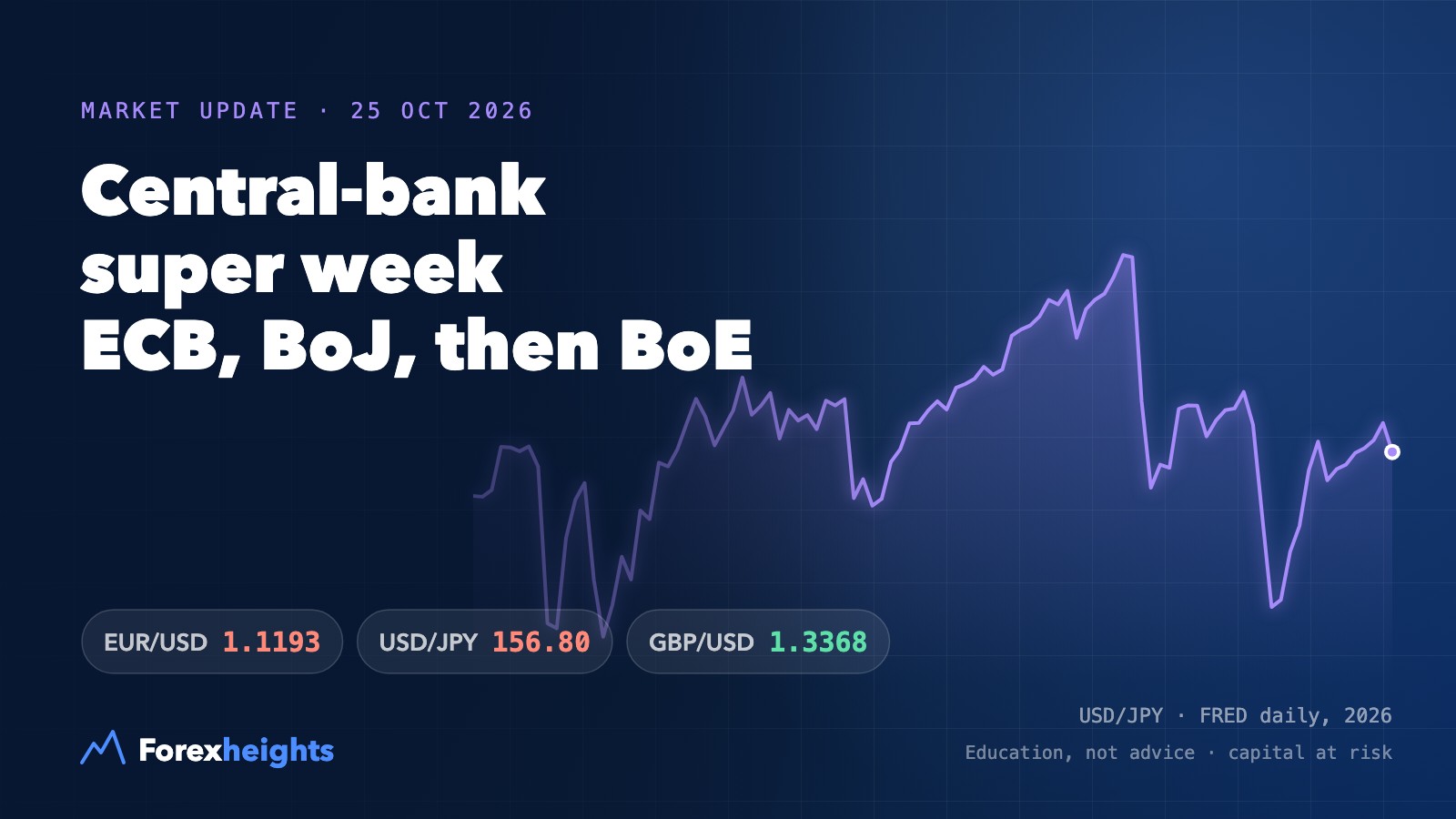
The ECB decides on Thursday 29 October, the Bank of Japan on Friday 30 October and the Bank of England on Thursday 5 November, the week after the UK Budget. New Zealand and Canada go first, on Wednesday 28 October, alongside the Fed. Markets expect the ECB and BoJ to hold now and the BoE to hike.
When are the central bank decisions this week and next?
UK and European clocks went back today; US clocks follow on Sunday 1 November. Times in UTC, with India, the UAE and Nigeria in brackets:
- RBNZ: Wednesday 28 October, 01:00 UTC (06:30 IST, 05:00 UAE, 02:00 Nigeria).
- UK Budget: Wednesday 28 October, usually around 12:30 UTC after Prime Minister's Questions (18:00 IST). No start time has been published.
- Bank of Canada: Wednesday 28 October, 13:45 UTC (19:15 IST, 17:45 UAE, 14:45 Nigeria) (BoC).
- Fed: Wednesday 28 October, 18:00 UTC (23:30 IST, 22:00 UAE, 19:00 Nigeria). Full guide: Fed meeting October 2026.
- ECB: Thursday 29 October, 13:15 UTC (18:45 IST, 17:15 UAE, 14:15 Nigeria), with the press conference 30 minutes later (ECB).
- Bank of Japan: Friday 30 October. There is no fixed time. It usually lands around midday in Tokyo, about 03:00 UTC (08:30 IST, 07:00 UAE, 04:00 Nigeria) (BoJ).
- Bank of England: Thursday 5 November, 12:00 UTC (17:30 IST, 16:00 UAE, 13:00 Nigeria), with a new Monetary Policy Report (BoE).
Our economic calendar shows each one in your own time zone.
Will the ECB raise rates in 2026?
It already has, twice. The deposit rate is 2.50% after moves in June and September (ECB). In a Reuters poll taken Monday 5 to Thursday 8 October, 70 of 73 economists expected a hold on Thursday, and 64 of 73 expected another hike in December (Reuters via Admiral Markets). Euro-area inflation was 3.8% in September, according to Reuters (RTÉ).
EUR/USD: 1.1193 on Friday (ECB reference rate), 4.7% lower this year by our calculation, and close to its 2026 low of 1.1177 on Wednesday 7 October. France has been the bigger weight this month: its 10-year borrowing costs hit 24-year highs above 5% (RTÉ), and its risk premium is the highest since 2011 (AsiaOne). With a hold and a December hike both expected, our read is that the surprise risk sits in the wording and in French bonds.
Will the Bank of Japan raise rates in December?
The BoJ's rate is 1.25% after a 7–2 vote on Friday 18 September (BoJ). It is expected to hold on Friday 30 October, when it also publishes its quarterly Outlook Report. For the meeting on Thursday 17 and Friday 18 December, sources disagree: traders priced 61% odds of a hike on Friday (AsiaOne), while BBH and Newsquawk put it nearer 80%.
USD/JPY: 156.80 on Friday (ECB reference rate). Safe-haven buying after Thursday's AI-stock sell-off gave the yen its best week since mid-September (AsiaOne). The 2026 peak was 163.91 on Tuesday 28 July (ECB reference rate). Japan and the US then jointly intervened to support the yen on Friday 31 July, as both governments confirmed (Al Jazeera).
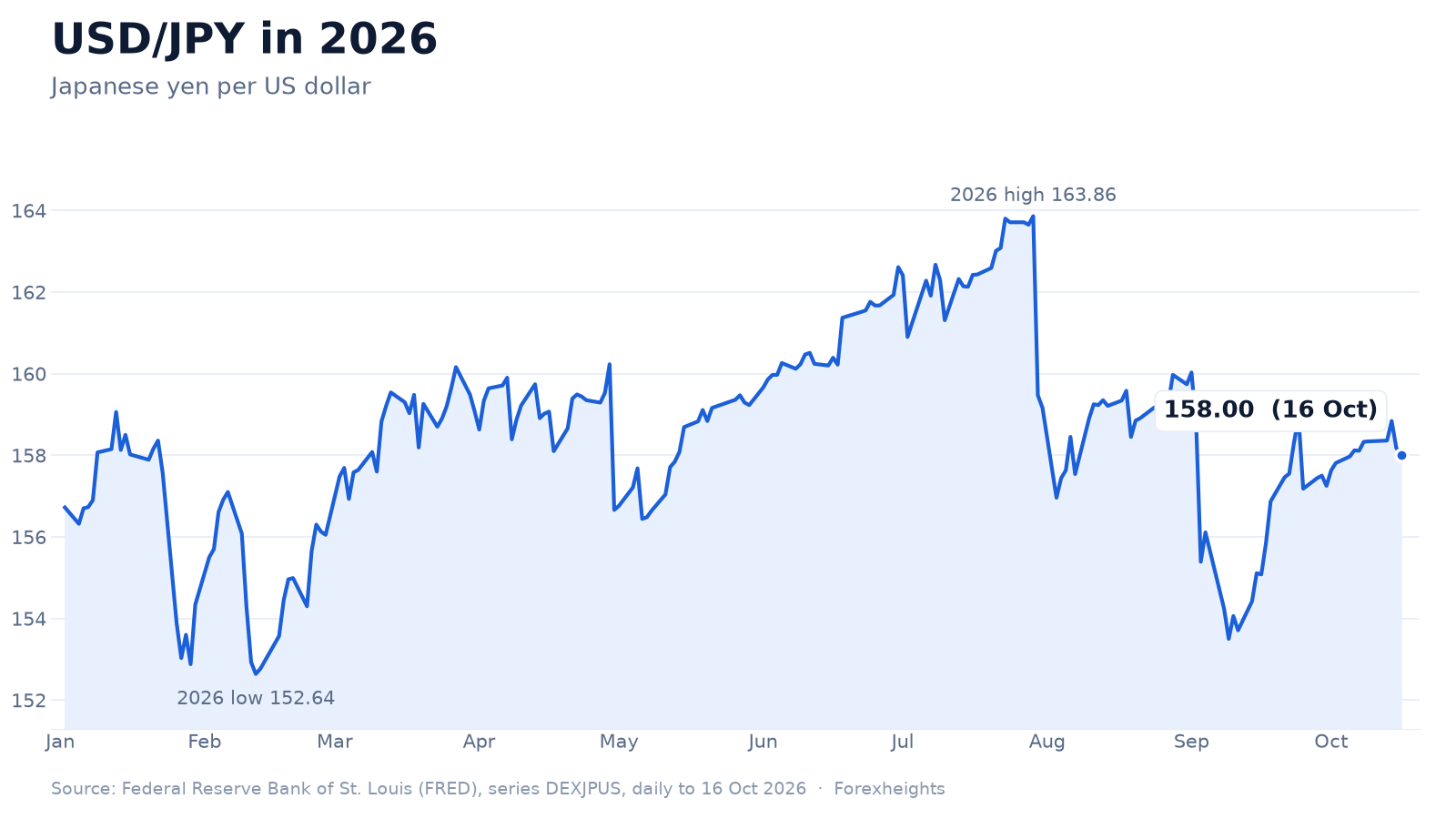
Source: FRED, Federal Reserve Bank of St. Louis: one New York noon rate per day, to Friday 16 October. The ECB reference rates quoted above are fixed earlier in the day, so the figures differ slightly.
When does the Bank of England next meet?
Thursday 5 November, at 12:00 UK time. Bank Rate is 3.75%. In September the vote was 6–3, with three members voting to raise it to 4% (BoE). UK inflation then rose to 3.5% in September, with services at 3.7% (ONS). Traders had priced roughly 96% odds of a quarter-point hike in November (investingLive).
First comes Chancellor John Healey's first Budget, on Wednesday 28 October (gov.uk). Newsquawk expects a low-key one, with headroom falling to around £15 billion and a £2–5 billion tax rise for banks.
GBP/USD: 1.3368 on Friday (ECB reference rate), up for a second week (FXStreet) and 0.7% lower this year by our calculation. With a hike almost fully priced, our read is that the Budget and the BoE's December hints matter more.
What about Canada and New Zealand?
- RBNZ: the official cash rate is 2.75%. ANZ, BNZ and ASB expect a hike to 3.00%; Westpac expects a hold. Markets priced roughly 75–80% for a hike (Newsquawk, Friday 23 October).
- Bank of Canada: the policy rate is 2.25%. Newsquawk put hike odds at 80% and said RBC now forecasts a hike; two days earlier, Admiral Markets reported TD and RBC expecting a hold.
How do you trade a central-bank week without getting caught out?
Spreads widen and stops slip in the first minutes after each decision. The Fed, ECB, BoJ and BoE all decide within nine days, so that risk keeps coming round. Before each one:
- Mark the time in your zone on the economic calendar.
- Size down. Work out the size from your maximum loss with the position size calculator.
- Know what one pip is worth on your lot size before the release, using the pip value calculator.
- Count your real exposure. Three trades that all lose if the dollar falls are one big trade.
- If you can't do all four before the ECB at 13:15 UTC on Thursday, skip it. There is always another decision.
What are the key numbers?
- EUR/USD 1.1193, USD/JPY 156.80, GBP/USD 1.3368 on Friday 23 October (ECB reference rates).
- Policy rates: ECB 2.50%, BoJ 1.25%, BoE 3.75%, BoC 2.25% (central bank websites), RBNZ 2.75% (Newsquawk).
- ECB December hike: expected by 64 of 73 economists (Reuters poll).
- BoE November hike: about 96% priced (investingLive).
- BoJ December hike odds: 61% (AsiaOne) or about 80% (BBH, Newsquawk).
Choosing a broker for weeks like this? Compare costs before offers: the spread at news time matters more than any welcome bonus. Check yours with the true cost per lot tool. This is what is on our desk board this week.
We are an introducing broker: if you open an account through our link, the broker pays us a commission.
74–89% of retail CFD accounts lose money (brokers' own EU disclosures). This offer is not for residents of India, Pakistan, the Philippines, Indonesia or the USA. If you live in India, read what is allowed in our rupee explainer.
New to pips, lots and spreads? Our free workbook covers them in 25 short lessons with exercises, the ones most beginners skip, then pay for. Free until Wednesday 11 November, then $4.99.
What else are people asking?
When does the Bank of England next meet?
Thursday 5 November 2026, at 12:00 UK time (17:30 IST). The next one is on Thursday 17 December.
Will interest rates go up in November in the UK?
Markets think so: traders priced about 96% odds of a rise to 4% (investingLive, Wednesday 21 October), and three of nine MPC members voted for a hike in September. Nothing is certain until the vote.
Will the ECB hike rates in 2026?
It already has, twice, to 2.50%. Most economists polled by Reuters expect a hold on Thursday 29 October and a hike in December.
Is there any yen intervention news?
The last confirmed intervention was the joint Japan–US action on Friday 31 July, after USD/JPY hit its 2026 high. We found no newer confirmed intervention as of Sunday 25 October.
Not advice. This is general education from an introducing-broker desk, not personalised investment advice. Leveraged trading carries a high risk of loss. Read the full disclosures.