Market update · 25 October 2026
USD to INR: Why the Rupee Is Near Its Record Low in 2026
USD to INR was 94.94 on 23 Oct, 2% from the 96.96 record low. What the RBI's rate hike, derivatives rules and oil-company dollar window mean for you.
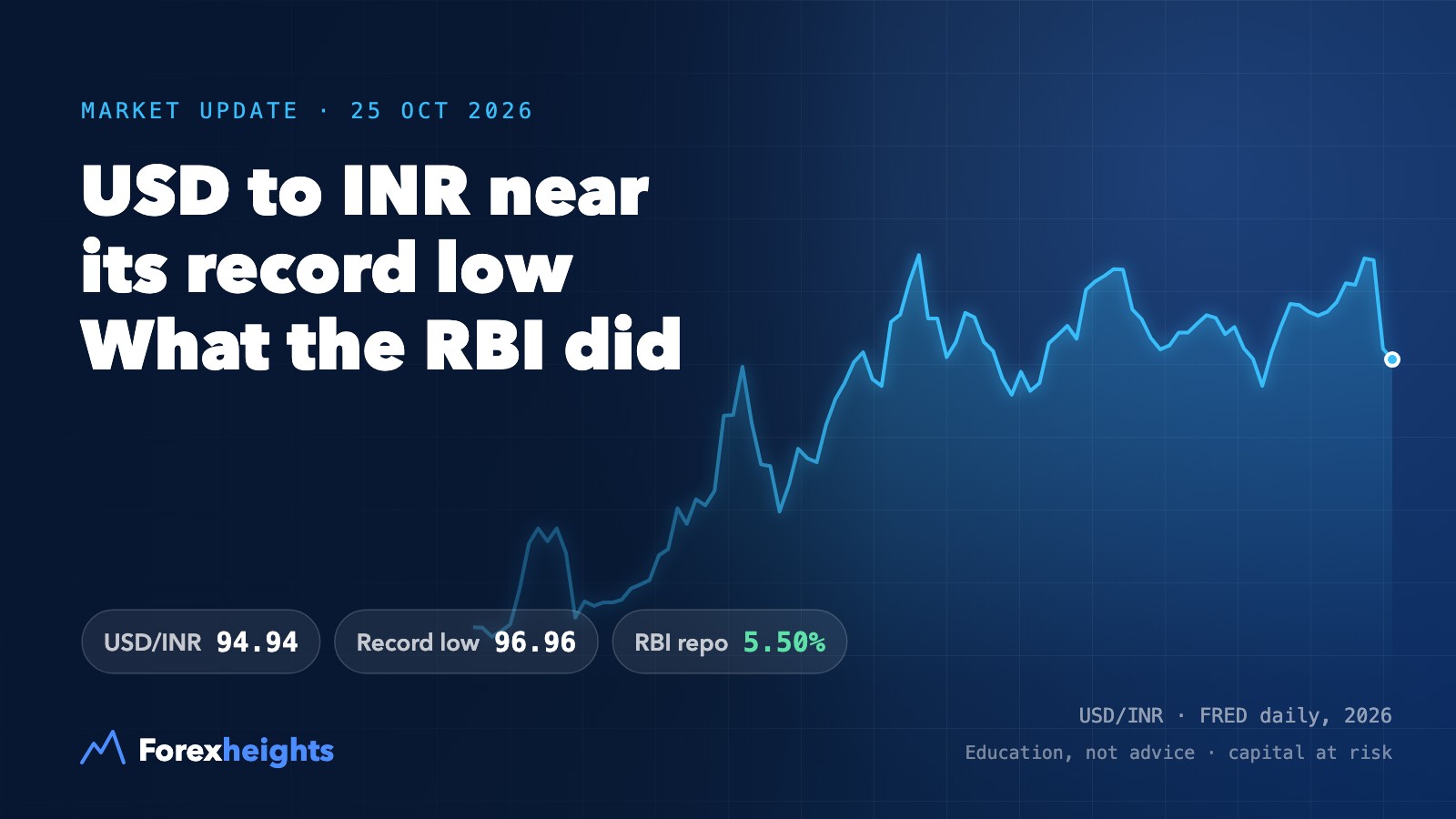
USD to INR was 94.94 on Friday 23 October, using the RBI's reference rate. That is about 2% away from the rupee's record low of 96.96, hit in May. The rupee has clawed back about 1.9% since Thursday 8 October, after the RBI raised rates, tightened currency-derivatives rules and opened a dollar window for oil companies.
Why is the rupee falling against the dollar?
The number first: the rupee has lost about 5.3% against the dollar this year, by our calculation from ECB reference rates. Three pressures stand out:
- Oil. India is a major oil importer, so dearer crude means buying more dollars. Brent settled at $116.72 on Friday, its highest close since Wednesday 29 April (Reuters). The RBI's own policy minutes list "rising crude oil prices" and "exchange rate depreciation" among the risks to inflation (RBI).
- Foreign selling. Foreign portfolio investors pulled ₹52,100 crore out of Indian shares in October up to mid-month, taking 2026 outflows to ₹3.12 lakh crore (Swarajya).
- US yields. Bloomberg reported that surging US bond yields make Indian assets less attractive (ThePrint). The US 10-year yield was 5.00% on Friday.
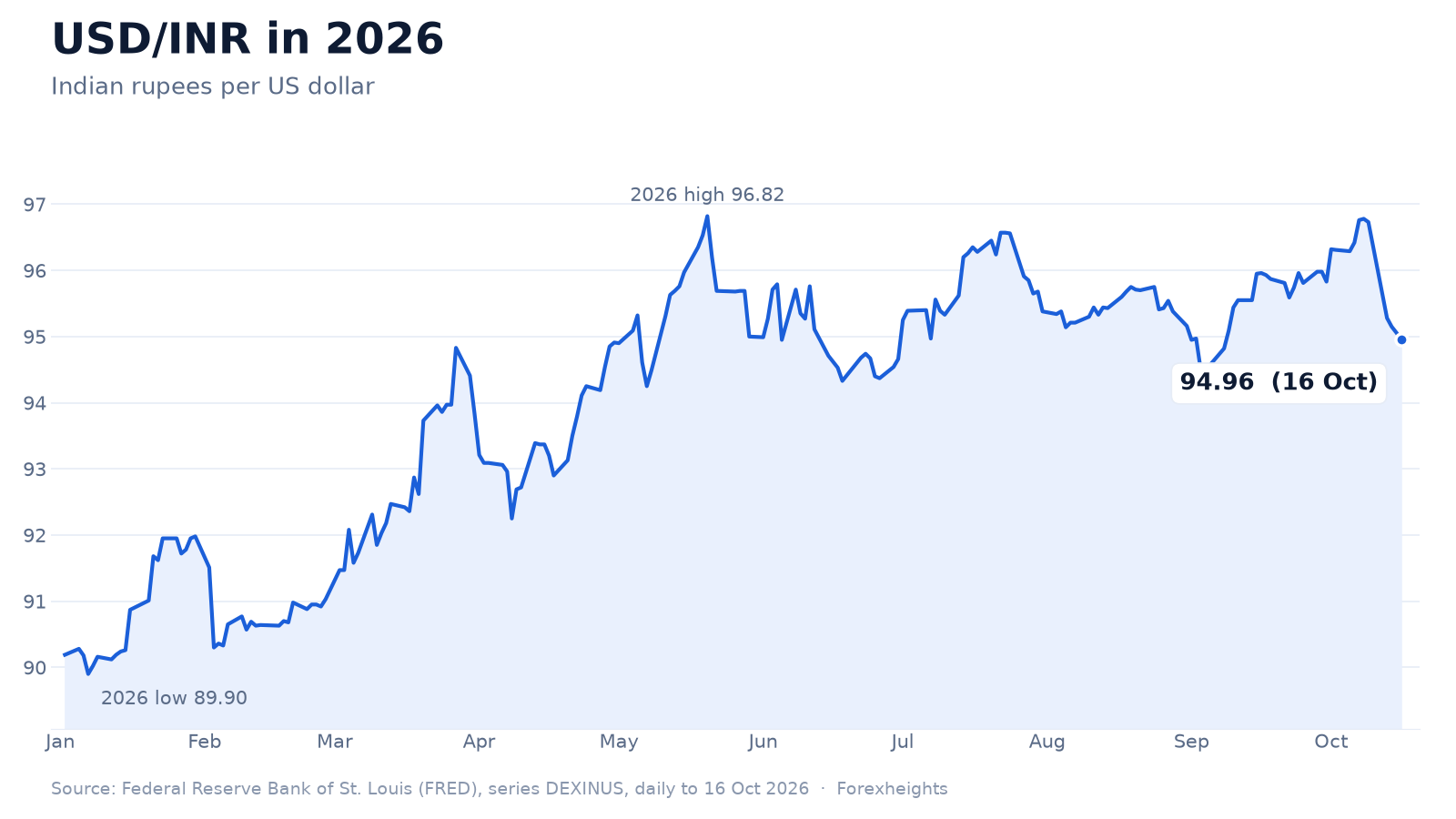
Source: FRED, Federal Reserve Bank of St. Louis: one New York noon rate per day, to Friday 16 October. Intraday extremes such as May's 96.96 record fall between those daily readings, so the chart's high is slightly lower.
What has the RBI done to support the rupee?
A lot, in three weeks:
- A rate hike. On Wednesday 7 October the RBI's Monetary Policy Committee voted unanimously to raise the repo rate by 25 basis points to 5.50%. It changed its stance to "calibrated tightening", which the minutes say means rate cuts are "off the table in the near term" (RBI).
- Derivatives rules. From Saturday 10 October, banks may not let customers rebook a cancelled rupee derivative contract. The limit for positions taken without proving an underlying exposure fell from $100 million to $5 million (Circular No. 25). Banks must also park a 20% cash "foreign exchange risk reserve" with the RBI on rupee contracts above $2 million that hedge current-account payments where the customer buys foreign currency (Circular No. 26). On Monday 12 October the RBI limited non-deliverable rupee contracts for non-residents to hedging only (Circular No. 27).
- A dollar window for oil companies. From Monday 12 October, Indian Oil, Hindustan Petroleum and Bharat Petroleum can get dollars from the RBI instead of buying them in the market, Reuters reported (Khaleej Times). That takes a big, steady buyer of dollars out of the spot market.
- Reserves. Foreign-exchange reserves were $721.0 billion on Friday 16 October, down $5.0 billion in a week (RBI). They peaked at about $785 billion in the week to Friday 4 September, and Bloomberg reported that the RBI has been selling dollars to defend the rupee.
What do the RBI's new forex rules mean for ordinary traders?
For most small traders on NSE or BSE, not much. A post on Zerodha's TradingQnA forum put it plainly: "For most small retail traders, the reduction in the threshold may not have much practical impact" (TradingQnA). The $5 million limit is combined across every rupee pair and exchange, so $4 million on NSE plus $2 million on BSE would breach it.
Who feels it: importers, exporters and anyone who used to cancel and rebook hedges to chase a better rate. That door is now shut.
For NRIs and Gulf families sending money home: the RBI's reference rate was ₹25.85 per dirham on Friday (RBI). Because the dirham is pegged to the dollar, AED to INR moves almost exactly with USD to INR.
What are the rules for trading forex from India?
This is the part many forex sites leave out. The RBI says residents may deal in forex only with authorised persons and for permitted purposes under FEMA. Electronic trades must be on RBI-authorised platforms or on the recognised exchanges: NSE, BSE and the Metropolitan Stock Exchange of India (RBI). For trading currency derivatives, that means the contracts those exchanges list, through a SEBI-registered broker.
- The RBI keeps an Alert List of unauthorised forex platforms. It says the list "is not exhaustive", and that an entity missing from it "should not be assumed to be authorised".
- Residents who trade on unauthorised platforms are "liable for legal action under the FEMA", the same release says.
- Sending margin money to overseas exchanges or counterparties is not permitted under the Liberalised Remittance Scheme (RBI).
- The latest update we found, in November 2025, took the list to 95 names (Gulf News). Check the current list on rbi.org.in before you sign up anywhere.
That is also why there is no broker offer on this page.
What could move USD to INR next?
We don't publish forecasts, but we can tell you when the risk is. All times are IST:
- Wednesday 28 October, 23:30: the Fed decision. See our Fed meeting guide.
- Thursday 29 October, 18:00: US growth and PCE inflation data.
- Sunday 1 November: OPEC+ meets, and oil reacts when markets reopen. See Brent crude above $115.
- Friday 6 November, 19:00: the US jobs report.
- Friday 4 December: the RBI's next policy decision (RBI).
The catch for exchange traders: rupee futures on NSE and BSE are shut at 23:30 IST, so the Fed's effect arrives at the next morning's open. If prices gap, a stop-loss can fill beyond your level. Size for that with the position size calculator, and check event times on the economic calendar.
What are the key numbers?
- USD/INR: 94.94 on Friday 23 October (RBI reference rate).
- Record low: 96.96 in May (Reuters via Khaleej Times). Bloomberg puts it at 96.97.
- The rupee this year: down about 5.3% (our calculation from ECB reference rates).
- Repo rate: 5.50% from Wednesday 7 October (RBI).
- Reserves: $721.0 billion on Friday 16 October (RBI).
- AED/INR: 25.85 on Friday 23 October (RBI).
Pips, lots and leverage work the same on NSE as anywhere else. Our free workbook teaches them in 25 short lessons with exercises. It is free until Wednesday 11 November, then $4.99.
What else are people asking?
What is the rupee's all-time low against the dollar?
About 96.96 per dollar, hit in May 2026, according to Reuters (Bloomberg says 96.97). On Friday 23 October the rupee was at 94.94, about 2% stronger.
Why is the rupee falling against the dollar?
Oil above $115, foreign investors selling Indian shares and high US bond yields. The RBI has pushed back with a rate hike, tighter derivatives rules, a dollar window for oil companies and dollar sales.
What are the RBI's new forex rules?
From Saturday 10 October: no rebooking of cancelled rupee derivative contracts, and a $5 million limit, down from $100 million, on positions without a proven exposure. Banks also hold a 20% cash reserve on certain hedging contracts above $2 million. Most small retail traders are not affected.
What is AED to INR today?
The RBI's reference rate was ₹25.85 per dirham on Friday 23 October, the latest before the weekend. Because the dirham is pegged to the dollar, it moves with USD to INR.
Not advice. This is general education from an introducing-broker desk, not personalised investment advice. Leveraged trading carries a high risk of loss. Read the full disclosures.